
Food Quality Enhancement Made Simple for Your Kitchen
July 2, 2026
Food quality enhancement transforms every kitchen into a place of freshness and taste. Simple habits make food safety possible for anyone. Clean hands, organized storage, and mindful food preparation all support safe food. People who focus on food quality enhancement enjoy meals that stay fresh longer. They prevent food poisoning and boost safety for their families. > Small steps in food quality enhancement lead to big gains in safety and satisfaction. Every meal becomes a celebration of food done right when food quality enhancement takes center stage.
Key Takeaways
- Choose fresh ingredients to enhance taste and nutrition. Look for firm produce and intact packaging when shopping.
- Practice proper handwashing to prevent foodborne illness. Wash hands before and after handling food to keep meals safe.
- Organize your fridge and pantry to reduce spoilage. Store raw meats on the bottom shelf and use airtight containers for dry goods.
- Use a food thermometer to ensure meats are cooked to safe temperatures. This step prevents harmful bacteria from causing illness.
- Handle leftovers safely by cooling them quickly and reheating to the right temperature. This keeps food fresh and safe to eat.
Food Quality Enhancement Starts with Smart Choices
Select Fresh Ingredients
Smart choices begin at the market. They set the stage for every meal. Fresh ingredients bring out the best in food. They deliver superior taste, nutrition, and visual appeal. Local growers help ensure produce reaches the kitchen at its peak, preserving nutrients and flavor. The Thompson family enjoys fresh salads and pancakes at their favorite restaurant. Their experience shows how fresh ingredients create a sense of home and community.
Selecting the best food means knowing what to look for. Use these tips to guide every shopping trip:
- Choose produce that feels firm and smells fresh.
- Avoid slimy or wet packaging.
- Pick meat with intact packaging, a neutral smell, and the right color.
- Select fish with a clean sea scent, clear eyes, and resilient flesh.
Here is a quick reference table for freshness:
| Category | Criteria |
|---|---|
| Produce | Firmness, aroma, skin integrity, moisture (avoid slimy, wet packaging) |
| Meat | Packaging integrity, neutral smell, appropriate color, fat quality |
| Fish | Clean ‘sea’ smell, clear eyes (for whole fish), resilient flesh, minimal liquid in tray |
Fresh ingredients pack essential vitamins, minerals, and fiber. They support health and make every bite enjoyable. Unprocessed food keeps its natural flavors and textures. These qualities help families enjoy meals and stay healthy.
Check Labels and Dates
Checking labels and dates is a simple way to boost food quality. Many people make mistakes that lower food safety. They ignore humidity control, skip inventory checks, or overstock shelves. These errors can lead to spoilage and waste.
Tip: Always use the FIFO (First In, First Out) system. Place newer items behind older ones. This tip helps prevent spoilage and keeps food fresh.
Follow these tips for better results:
- Read expiration dates before buying.
- Store food at the right humidity and temperature.
- Avoid blocking airflow in the fridge or pantry.
- Rotate stock to use older items first.
These tips protect families from food poisoning and waste. They also keep food tasting its best. Smart choices and simple tips make food quality enhancement easy for everyone.
Food Safety Through Cleanliness
Handwashing and Hygiene
Food safety begins with clean hands. Many people overlook this simple step, but it remains the most effective way to prevent foodborne illness. Studies show that handwashing can reduce microbial load by up to 99%. Experts agree that frequent handwashing keeps germs off food and protects health. Non-hygienic hand contact is a major pathway for pathogens to enter food, so everyone must follow proper guidelines.
To wash hands correctly, follow these steps:
- Wet hands with clean, running water.
- Apply soap and lather well, covering backs of hands, between fingers, and under nails.
- Scrub hands for at least 20 seconds. Humming the ‘Happy Birthday’ song twice helps track time.
- Rinse hands thoroughly under running water.
- Dry hands with a clean towel or air dry.
People should wash hands before and after handling food, after using the bathroom, after changing a diaper, after handling pets, after tending to a sick person, after blowing their nose, coughing, or sneezing, and after touching uncooked eggs, raw meat, poultry, or fish. These guidelines help prevent foodborne illness and keep meals safe.
Tip: Compliance with handwashing protocols is often below 40% in kitchens. Encourage everyone to follow guidelines and make handwashing a habit.
Proper kitchen attire also plays a role in safety. Wearing clean clothing and using hair restraints prevents contamination. Dirty aprons and clothing can transfer germs directly into food. Harmful microbes cling to fabric surfaces, increasing the risk of cross-contamination. People should always wear clean clothes and tie back long hair to protect food.
Clean Surfaces and Tools
Sanitation of kitchen surfaces and tools is essential for food safety. People must wash surfaces regularly to prevent contamination and maintain safety. Using the right cleaning agents makes a difference. Non-toxic cleaners reduce exposure to harmful chemicals. Antimicrobial agents kill bacteria and germs on surfaces. Food-safe sanitizers ensure that surfaces contacting food remain safe.
Here is a table showing recommended cleaning intervals:
| Cleaning Interval | Description |
|---|---|
| Before Opening and After Closing | Clean surfaces and tools to start and end the day |
| Immediately After Spills or Splatters | Address messes right away to prevent contamination |
| Between Tasks or Ingredient Types | Clean tools when switching between food types |
| During Equipment Changeovers or Downtime | Sanitize when equipment is not in use |
| After Equipment Use | Clean tools after they have been utilized |
| Upon Visible Soil Accumulation | Clean whenever dirt or debris is seen |
| Before Sanitizing Food-Contact Surfaces | Ensure surfaces are clean before applying sanitizer |
People should wash surfaces whenever they finish a food prep task, switch between food types, or see visible soil. Cleaning every four hours also supports safety. Guidelines recommend using peroxyacetic acid, iodophors, quaternary ammonium, or chlorine-based sanitizers. Each option has benefits and drawbacks, so choose what fits the kitchen best.
Note: Always wash fruits and vegetables before preparing them. This step removes dirt and germs, supporting food safety and sanitation.
Sanitation guidelines help prevent foodborne illness and keep meals safe. Clean dishcloths or paper towels should be used instead of dirty rags. People who follow these guidelines enjoy safer meals and healthier families.
Prevent Food Poisoning with Proper Storage
Fridge & Pantry Organization
Organizing the fridge and pantry creates a strong foundation for food safety. People who arrange their storage areas wisely reduce the risk of cross-contamination and spoilage. They protect their families from harmful bacteria and keep meals fresh.
A well-organized fridge separates raw and ready-to-eat foods. Raw meat, poultry, and fish belong on the bottom shelf in sealed containers. This placement prevents juices from dripping onto other items. Dairy and eggs fit best on the middle shelves. Leftovers and ready-to-eat foods stay safest on the top shelves. Crisper drawers serve different purposes. High-humidity drawers keep leafy greens crisp, while low-humidity drawers preserve fruits that produce ethylene.
The fridge door handles frequent temperature changes. People should store condiments there, not sensitive items like milk or eggs. Overpacking blocks airflow and causes uneven cooling. Designating an “Eat First” area helps families use older items before newer ones. Practicing First-In, First-Out reduces waste and supports safety.
Pantry organization matters as much as fridge arrangement. Dry goods need airtight containers to keep out moisture and pests. Clear containers improve visibility and make inventory checks easier. Shelves should separate allergenic foods from others to prevent accidental exposure.
- Store raw meat, poultry, and fish on the bottom shelf in sealed containers.
- Place dairy and eggs in the middle shelves.
- Keep leftovers and ready-to-eat foods on the top shelves.
- Use crisper drawers correctly for greens and fruits.
- Keep condiments on the fridge door.
- Designate an “Eat First” area and practice First-In, First-Out.
- Avoid overpacking to maintain airflow.
Tip: A clean and organized fridge or pantry makes food safety simple and effective. Families who follow these steps enjoy fresher meals and fewer risks.
Safe Temperatures and Containers
Maintaining the right temperature is essential for food safety. People who refrigerate perishable foods immediately stop bacteria from multiplying. The “danger zone” for food lies between 41 and 135 degrees Fahrenheit. Food left at room temperature enters this zone and becomes unsafe quickly.
Refrigeration slows bacterial growth but does not eliminate it. Freezers keep food safe by halting bacteria. The refrigerator should stay at or below 40 degrees Fahrenheit. The freezer must remain at 0 degrees Fahrenheit. Hot foods need to stay at or above 140 degrees Fahrenheit to prevent bacteria.
| Food Type | Recommended Temperature Range |
|---|---|
| Danger Zone | 41 to 135 degrees Fahrenheit |
| Safe Refrigerator Temp | At or below 40 degrees Fahrenheit (4 degrees Celsius) |
| Safe Freezer Temp | 0 degrees Fahrenheit (-18 degrees Celsius) |
| Hot Foods | At or above 140 degrees Fahrenheit |
Improper storage leads to bacteria and mold growth. Perishable food left at room temperature becomes dangerous. Extended refrigeration allows certain bacteria to grow over time. Poor cooling and inadequate sealing create conditions for pathogens.
| Contributing Factor | Description |
|---|---|
| Inadequate cold holding temperature | Occurs due to practices like overloaded refrigerators, leading to poor air circulation. |
| Inadequate hot holding temperature | Caused by malfunctioning equipment or improper practices, resulting in food being held at unsafe temperatures. |
| Improper cooling of food | Large quantities or poorly controlled temperature storage allows pathogens to multiply. |
| Extended refrigeration | Certain bacteria can grow over time at ordinary refrigerator temperatures, leading to illness. |
| Inadequate reduced oxygen packaging | Improper sealing methods create conditions for anaerobic bacteria growth. |
| Inadequate non-temperature dependent processes | Failure in processes like acidification allows pathogens to multiply. |
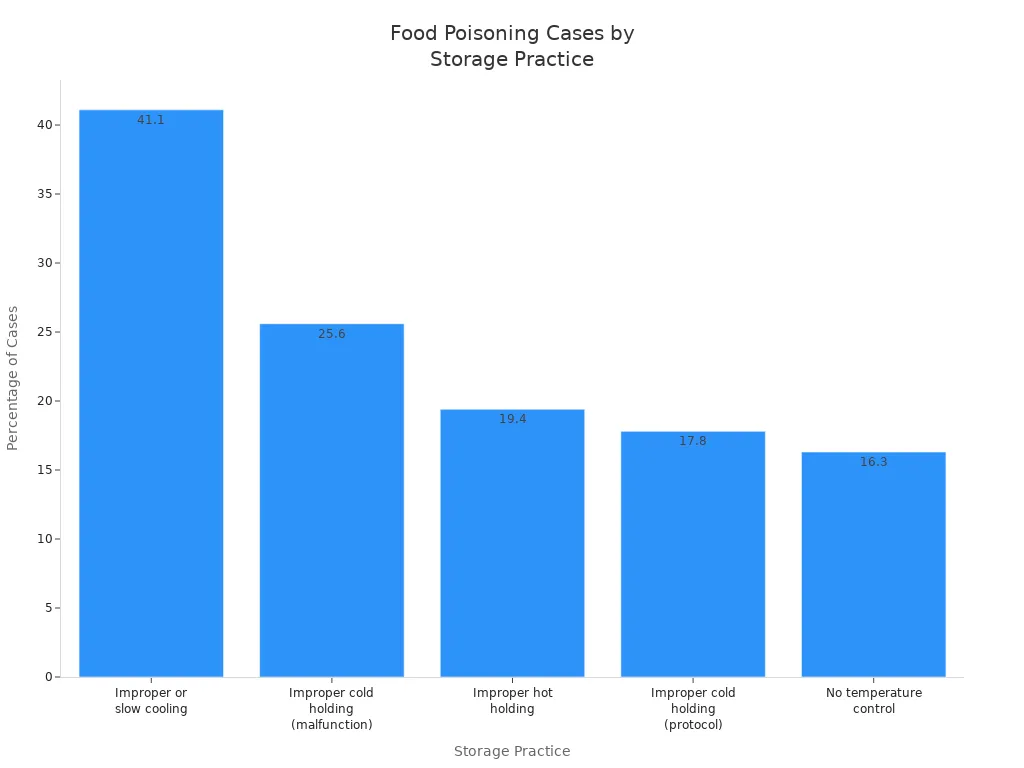
The chart above shows that improper or slow cooling causes over 40% of food poisoning cases. Improper cold holding and hot holding also contribute to many incidents. People who ignore temperature control put their families at risk.
Safe containers play a key role in food storage. Airtight containers keep food fresh and block bacteria. Glass and BPA-free plastic containers protect food from chemicals and odors. Families should discard any food that looks or smells suspicious.
- Refrigerate or freeze perishables immediately.
- Follow the “two-hour rule” for perishable foods at room temperature.
- Keep refrigerator at or below 40° F (4° C) and freezer at 0° F (-18° C).
- Use airtight containers for all food storage.
- Discard food that looks or smells suspicious.
Note: Food safety depends on proper storage and temperature control. Families who follow these guidelines prevent food poisoning and enjoy safer meals.
Cook to the Right Temperature
Avoid Cross-Contamination
Cross-contamination remains a leading cause of foodborne illness in home kitchens. Bacteria can move from raw meat, poultry, or fish to ready-to-eat food through hands, surfaces, or utensils. Kitchen faucets, stove knobs, and drainage pipes often hide germs. Cutting boards and knives can transfer bacteria from raw to cooked food if not cleaned properly. People must separate raw and cooked items to keep meals safe.
They should always wash hands before and after handling raw meat, poultry, or fish. Using color-coded cutting boards for meat, fish, and vegetables helps prevent the spread of germs. Dishcloths and sponges need regular replacement because they collect bacteria. Storing raw meat, poultry, and fish on the bottom shelf of the refrigerator stops juices from dripping onto other food. Good hygiene, proper storage, and careful cleaning keep the kitchen safe from the danger zone of contamination.
Tip: Segregate raw seafood, meat, and poultry from ready-to-eat food. This simple habit protects families from illness.
Use a Food Thermometer
Cooking food to the right temperature destroys harmful bacteria and keeps meals safe. Visual cues like color or texture do not guarantee safety. A food thermometer gives accurate readings and ensures that meat, poultry, and fish reach the correct temperature. Proper use and calibration of thermometers make them reliable tools in every kitchen.
The table below shows the recommended internal temperatures for different types of meat, poultry, and fish:
| Meat Type | Recommended Internal Temperature |
|---|---|
| Poultry | 165°F (74°C) |
| Ground Poultry | 165°F (74°C) |
| Ground Beef | 160°F (71°C) |
| Steak or Roast Beef | 145°F (63°C) |
| Veal | 145°F (63°C) |
| Ground Lamb | 160°F (71°C) |
| Lamb Chops | 145°F (63°C) |
| Pork | 145°F (63°C) |
| Ham | 145°F (63°C) |
| Precooked Ham | 165°F (74°C) |
| Venison Steak or Roast | 160°F (71°C) |
| Rabbit | 160°F (71°C) |
| Ground Bison | 160°F (71°C) |
| Bison Steak or Roast | 145°F (63°C) |
| Fish | 145°F (63°C) |
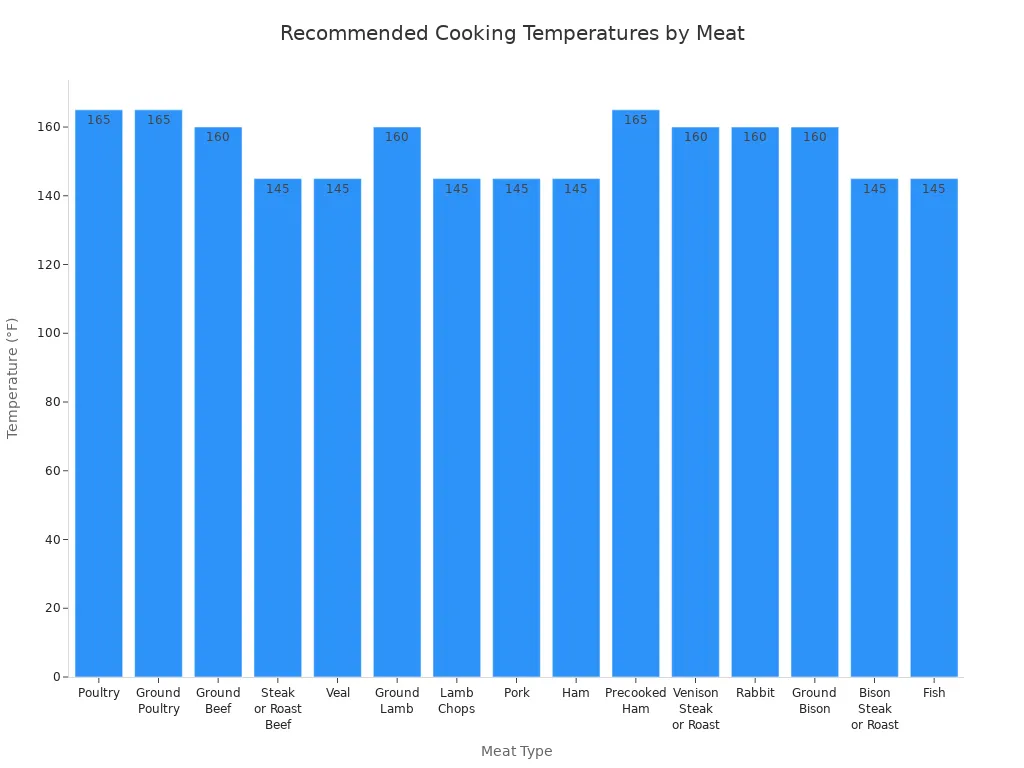
To use a food thermometer correctly, people should sanitize the probe before and after each use. They must insert it into the thickest part of the meat, poultry, or fish, avoiding bones and fat. For thin seafood or fish fillets, a digital thermometer works best. Multiple readings in large cuts ensure even cooking. Keeping records of cooking and cooling temperatures helps maintain safety.
Cooking food outside the temperature danger zone stops bacteria from growing. The right temperature for fish and seafood is 145°F (63°C). Ground meat and ground seafood need 160°F (71°C). Poultry and leftovers require 165°F (74°C). These steps guarantee that every bite is safe and delicious.
Note: A food thermometer is the only way to confirm that meat, poultry, and fish have reached a safe temperature. Protect every meal by making this tool a kitchen essential.
Handle Leftovers Safely
Cool and Store Properly
Safe handling of leftovers protects families from foodborne illness. He must cool food rapidly to prevent bacteria from multiplying. Harmful bacteria thrive between 40° F and 140° F, so food should never stay in this range for long. When food sits at room temperature for more than two hours, it becomes unsafe. If the room temperature exceeds 90° F, discard food after one hour. People should divide large portions into shallow containers to speed up cooling. This method helps food reach 40° F or below quickly.
Tip: Refrigerate leftovers within two hours to keep them safe.
The following table shows the risks of improper cooling and storage:
| Temperature Range | Recommendation |
|---|---|
| 40° F – 140° F | Bacteria grow rapidly; keep food hot at 140° F+ |
| > 2 hours | Throw away perishable foods left at room temperature |
| > 90° F | Discard food left out for more than 1 hour |
He should consume leftovers within three to four days. The table below shows safe storage times:
| Type of Food | Refrigeration Time | Freezer Time |
|---|---|---|
| Leftovers | 3 to 4 days | 3 to 4 months |
| Casseroles | 3 to 4 days | 4 to 6 months |
Reheat to Safe Temperatures
Reheating leftovers to the right temperature destroys bacteria and keeps meals safe. She must use a food thermometer to check that leftovers reach at least 165° F. Sauces, soups, and gravies require a rolling boil when reheated. This step ensures that every part of the food becomes hot enough to kill germs.
- Reheat leftovers to a minimum temperature of 165° F.
- Use a food thermometer for accuracy.
- Bring sauces, soups, and gravies to a rolling boil.
People who follow these steps protect their families from illness. They enjoy meals that taste fresh and safe. Handling leftovers with care makes food quality enhancement simple and effective.
They can transform any kitchen by adopting simple food safety habits. These steps protect vulnerable groups, reduce waste, and create efficient routines. Gradual changes in food handling lower the risk of foodborne illness and improve family health. The table below shows how steady improvements in food safety practices lead to better outcomes and awareness.
| Practice | Impact |
|---|---|
| Food safety routines | Fewer foodborne diseases, better nutrition |
| Hygiene improvements | Reduced pathogen spread |
| Preservation awareness | Stronger health surveillance |
People who monitor local health updates and follow FDA or USDA alerts stay ahead of food safety risks. Daily routines with proper cleaning and date marking help keep food safe. Every meal becomes a chance to protect loved ones and enjoy delicious food.
FAQ
How can someone quickly improve food quality at home?
He can start by choosing fresh ingredients and keeping the kitchen clean. These habits help meals taste better and stay safe. Small changes make a big difference.
What is the best way to prevent food poisoning?
She should store perishable food at the right temperature and use a food thermometer when cooking. These steps protect families from harmful bacteria.
Why does handwashing matter in the kitchen?
Handwashing removes germs before they touch food. They reduce the risk of illness and keep meals safe. Experts recommend washing hands often.
How should leftovers be handled for safety?
He must cool leftovers quickly and store them in airtight containers. Reheating to the correct temperature ensures safety and freshness.
What tools help maintain food safety?
They use color-coded cutting boards and food thermometers. These tools prevent cross-contamination and confirm safe cooking temperatures.